How Dialogue Flags in Games Create Branching Storylines

Think about an NPC thanking you for sticking up for them way back in the prologue. Or a random note you found early on suddenly unlocking a new chat option. Maybe you get a wild ending just because you were mostly nice, occasionally mean, and randomly pocketed a spoon. It feels incredibly tailored to you. But honestly, the tech pulling the strings is surprisingly basic. Branching stories usually work by relying on dialogue flags in games. But what are they really?
Dialogue Flags in Games: Tiny Variables, Big Story Changes
A flag is simply a stored piece of information that tells the game something has happened. The simplest version is a boolean, meaning it has only two possible states: true or false. Did the player help Maya? Did they open the basement? Did they learn the villain's real name? If the answer matters later, the game can record it and check it again when the story reaches the appropriate moment. Ren'Py's documentation demonstrates this basic approach directly by initializing variables and later checking them to change dialogue or available choices.
Not every choice fits neatly into yes-or-no logic. A counter can track degrees of change, such as maya_trust = 3, while a text value might remember which faction the player joined or which answer they gave earlier. Developers also use the word "flag" fairly loosely. Technically, an on/off boolean is the most literal kind of flag, but in narrative design the term often gets applied to many pieces of stored story state that can influence something later.
That is how dialogue flags in games can travel surprisingly far. Choosing to cover for Maya in Scene 1 might add two trust points. In Scene 2, that higher trust can unlock a confession instead of generic small talk. By Scene 3, the same decision can combine with evidence found elsewhere to unlock a special ending. The player experiences an evolving relationship. The game sees several variables quietly doing paperwork backstage and desperately hoping nobody renames them halfway through development.
What Gets Remembered: Browser Game Save Data
Here's a case for you. Consider a simple three-scene mystery. The story begins with three values: helped_maya = false, maya_trust = 0, and found_evidence = false. In Scene 1, the player can help Maya hide from a guard. Helping her flips the boolean to true and adds two trust points. Refusing changes nothing, which is important because a branch still needs a defined fallback. "Nothing changed" is a perfectly valid state, rather than an error condition wearing sunglasses and pretending everything is fine.
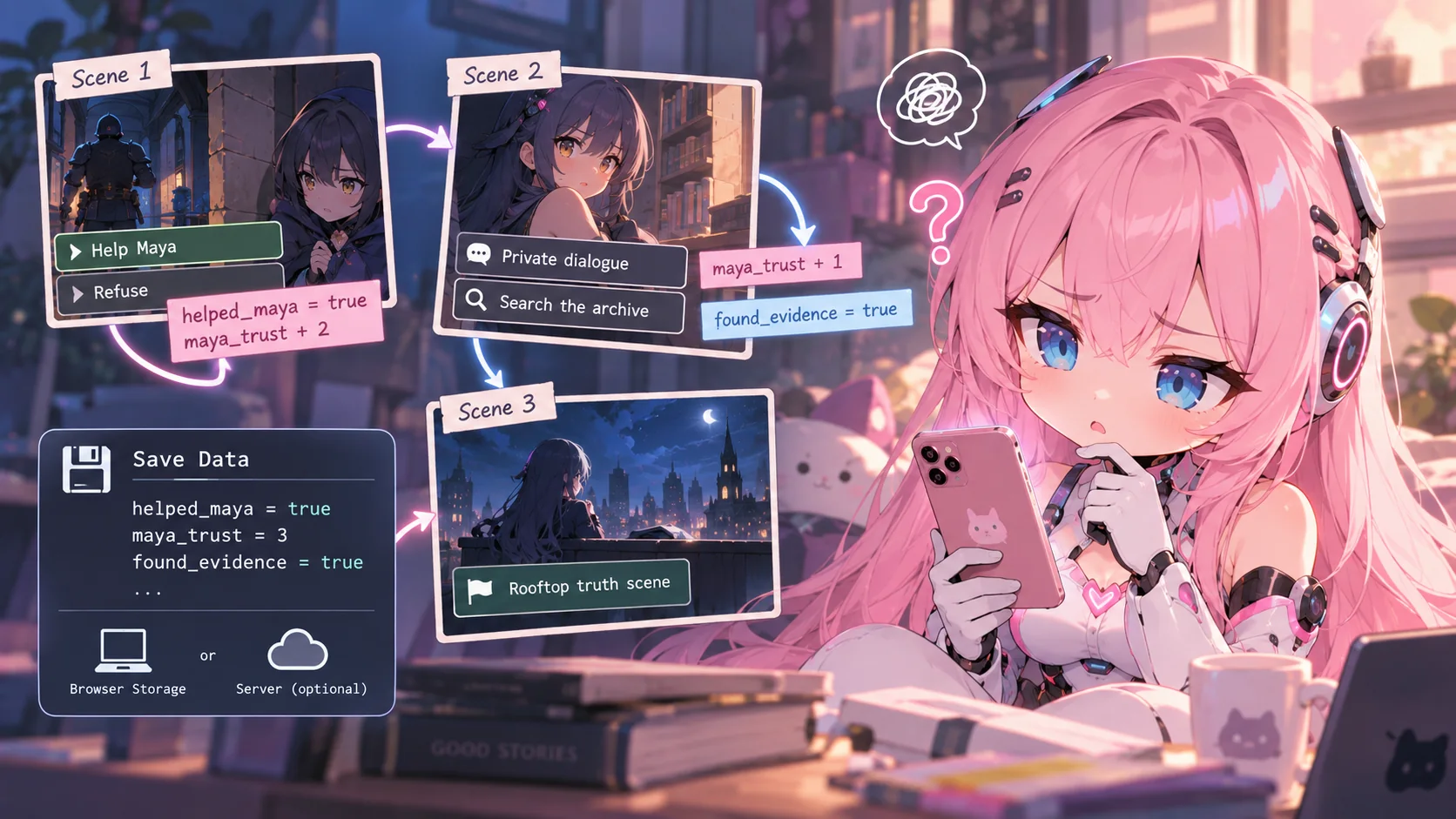
DEFAULT:
    helped_maya = false
    maya_trust = 0
    found_evidence = false
SCENE 1:
    if player helps Maya:
        helped_maya = true
        maya_trust += 2
SCENE 2:
    if helped_maya:
        show Maya's private dialogue
        maya_trust += 1
    else:
        show default dialogue
    if player searches the archive:
        found_evidence = true
SCENE 3:
    if maya_trust >= 3 AND found_evidence:
        show rooftop truth scene
    else if found_evidence:
        show cautious alliance scene
    else:
        show default departure ending
When a web game supports saving, those values may become part of its stored state so they survive a reload or later session. The exact method depends on the game. Web applications can use Web Storage for relatively simple key-value information or IndexedDB for more structured data, while online games may also keep progress on a server. Browser caching is a separate concept. The Cache API is designed around stored request and response resources, so keeping scripts or images cached is not the same thing as remembering that Maya trusts you.
That distinction becomes important when something breaks. Suppose a player reloads and Maya suddenly treats them like a stranger. The branching condition itself could be completely correct while the saved state failed to restore maya_trust. The opposite can happen too: the browser game save data correctly contains a value of three, but an incorrect condition sends the player to the ordinary ending anyway. Narrative state, saving, loading, and evaluating a branch are connected parts of the system, but they are still separate parts.
Conditions, Defaults, and How HTML5 Games Run Branches
"HTML5 game" is a broad description rather than the name of one universal game engine. A browser game may use HTML, CSS, JavaScript, WebAssembly, an exported engine runtime, or some combination of these technologies. At the end of the day, branching stories rely on checking the current state, regardless of your tech. The engine hits a crossroads, looks at your variables, and picks a path. You can see this in our setup. Scene 2 looks at simple dialogue flags in games before Maya speaks. Then, Scene 3 goes further, making sure a specific counter is high enough while also verifying another true-or-false condition.
Conditions can become much more complicated, but complicated branches are usually still combinations of small questions: "Is this true?", "Is this number high enough?", "Does the player possess this information?", or "Which route are they currently following?"
Defaults are especially important because every special branch needs a sensible result when its requirements are not met. A useful debugging pass should therefore test the ordinary route just as carefully as secret scenes:
- Confirm every variable begins with a known value before the first scene that checks it.
- Temporarily log important state after decisions, such as maya_trust = 2.
- Test counters below, exactly at, and above important thresholds.
- Deliberately test the default route where the player ignores every optional clue and behaves like an NPC speedrunning their commute home.
Without a fallback, players can encounter missing dialogue, broken navigation, or scenes that assume they know information they never learned. Secret branches tend to receive plenty of attention because they are exciting. The humble else condition gives players a route through the scene when none of the special requirements are met.
Ren'Py, RPG Maker, Twine, and What Players Actually See
The underlying logic remains similar across engines, but the tools used to express it can be quite different. Ren'Py commonly initializes mutable story variables with default, changes them during script execution, and uses conditional statements or conditions attached to menu choices. Variables modified during play can form part of a save state. Ren'Py also has a separate persistent object for information intended to exist independently of an individual save slot, such as an unlock that should remain available across playthroughs.
RPG Maker MZ presents similar concepts through its editor. Switches store ON or OFF states, variables store numerical values, Conditional Branch commands react to them, and event pages can appear only when specific conditions are satisfied. Twine works differently again because Twine projects use selectable story formats with their own syntax. Harlowe, for example, can set story variables using (set:) and test them using (if:), while SugarCube uses syntax such as <<set>> and <<if>>. Same basic logic, very different punctuation budget.
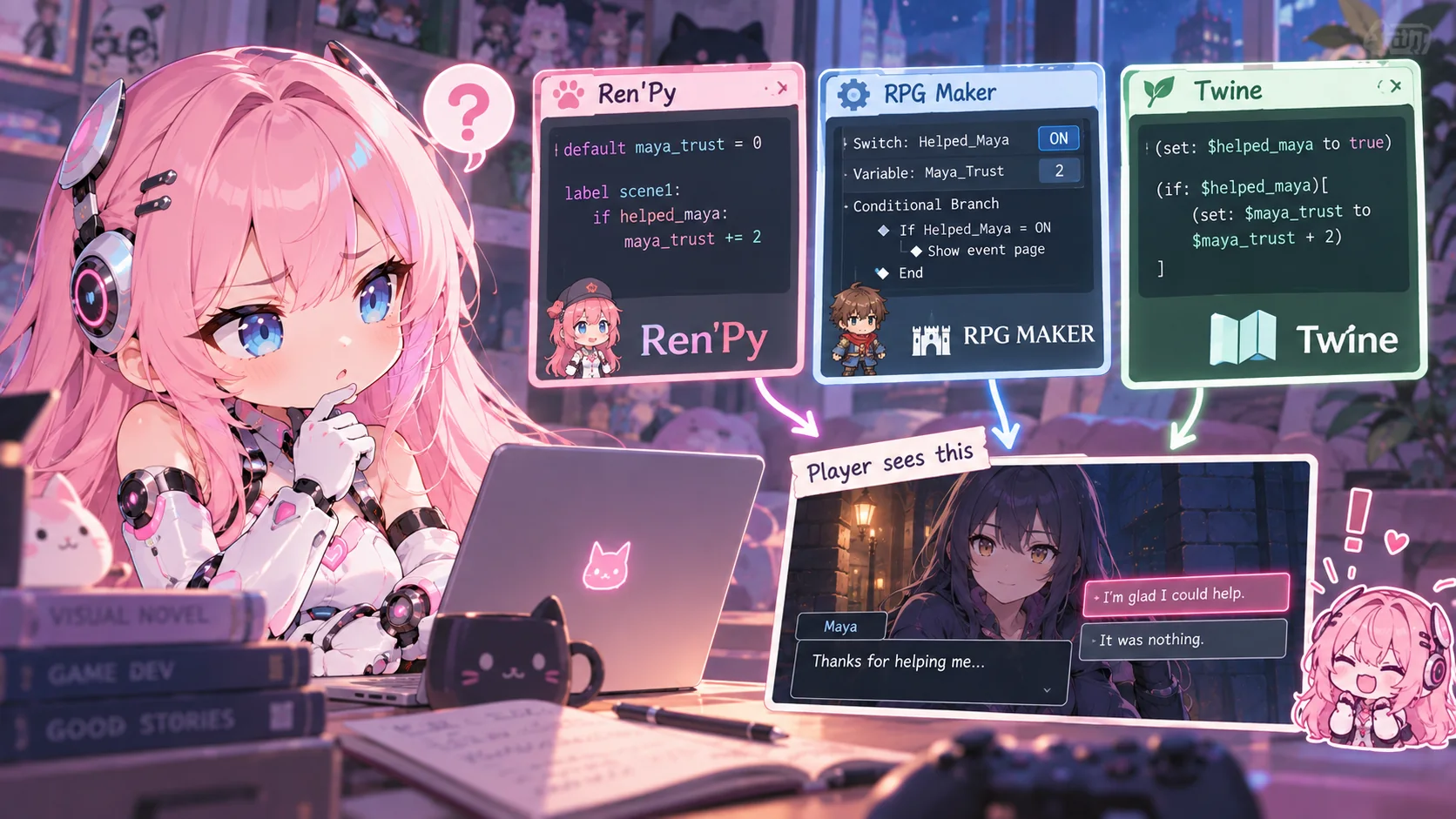
For the player, most of this implementation is invisible. A browser portal simply provides access to the finished experience while the individual game handles its own state and branching according to how it was built. Lewdspot works similarly from the player's perspective: you launch a game, make choices, and see the results without needing to care whether the creator used visual switches, script variables, or passage conditions underneath. The syntax changes, but "remember this now and react to it later" remains the important idea.
Why Dialogue Flags in Games Feel Bigger Than They Are
The clever part of branching design is that every decision does not need to create an entirely separate game. Paths can split and reconnect repeatedly. Two players might receive different conversations in Scene 2, return to the same investigation afterward, then separate again at Scene 3 because their stored values satisfy different ending conditions. This gives writers meaningful reactivity without requiring a completely unique script for every mathematically possible combination of choices.
Good systems also use state with some restraint. Giving every throwaway response its own permanent variable can make a project progressively harder to understand and test. A useful flag normally exists because somebody intends to ask about it again later. Every branching story basically boils down to tracking details: Did the player uncover the big secret? Did they actually earn the good ending?
It all hinges on cause and effect. An early decision flips a switch, and later scenes check that switch before deciding what happens next. Once you get a grip on the technical side—the booleans, stat counters, and debugging tools—navigating that massive dialogue tree feels way less overwhelming. You may still have plenty of scenes to test, but at least you haven't lost the ceremonial spoon.
Conclusion and Trying Dialogue Flags for Yourself
It’s easy to get overwhelmed looking at a game with many endings and dialogue paths, but the underlying mechanics are actually pretty simple. You just start by giving the player a single choice, remembering what they picked, checking it down the line, and setting a backup option just in case. Once you get the hang of that, simple true-or-false flags turn into point systems, those systems start crossing over, and suddenly you're seamlessly tracking whether Maya likes you enough to explain the whole bloody umbrella situation.
If this article has tempted you to try building a small narrative game yourself, choose your first engine based on how you prefer to work rather than which one seems most powerful. Ren'Py is an excellent starting point if you want to make visual novels and do not mind learning a little scripting. RPG Maker is friendly to people who prefer visual editors and want exploration or RPG mechanics alongside dialogue. Twine is especially approachable for mostly text-based interactive fiction and lets you experiment with branching structure before worrying about character sprites, combat systems, or elaborate interfaces.
Whichever one you choose, make something tiny first. A three-scene project like the example above is far more useful for learning than immediately planning a forty-hour epic with twelve romance routes and seventeen endings. Build one branch, inspect the variables, deliberately break it, fix it, and see how the state moves between scenes. Once that process makes sense, much larger branching stories stop looking like magic and start looking like a lot of small, understandable decisions connected together.