Visual Novel vs RPG: Where the Systems Meet
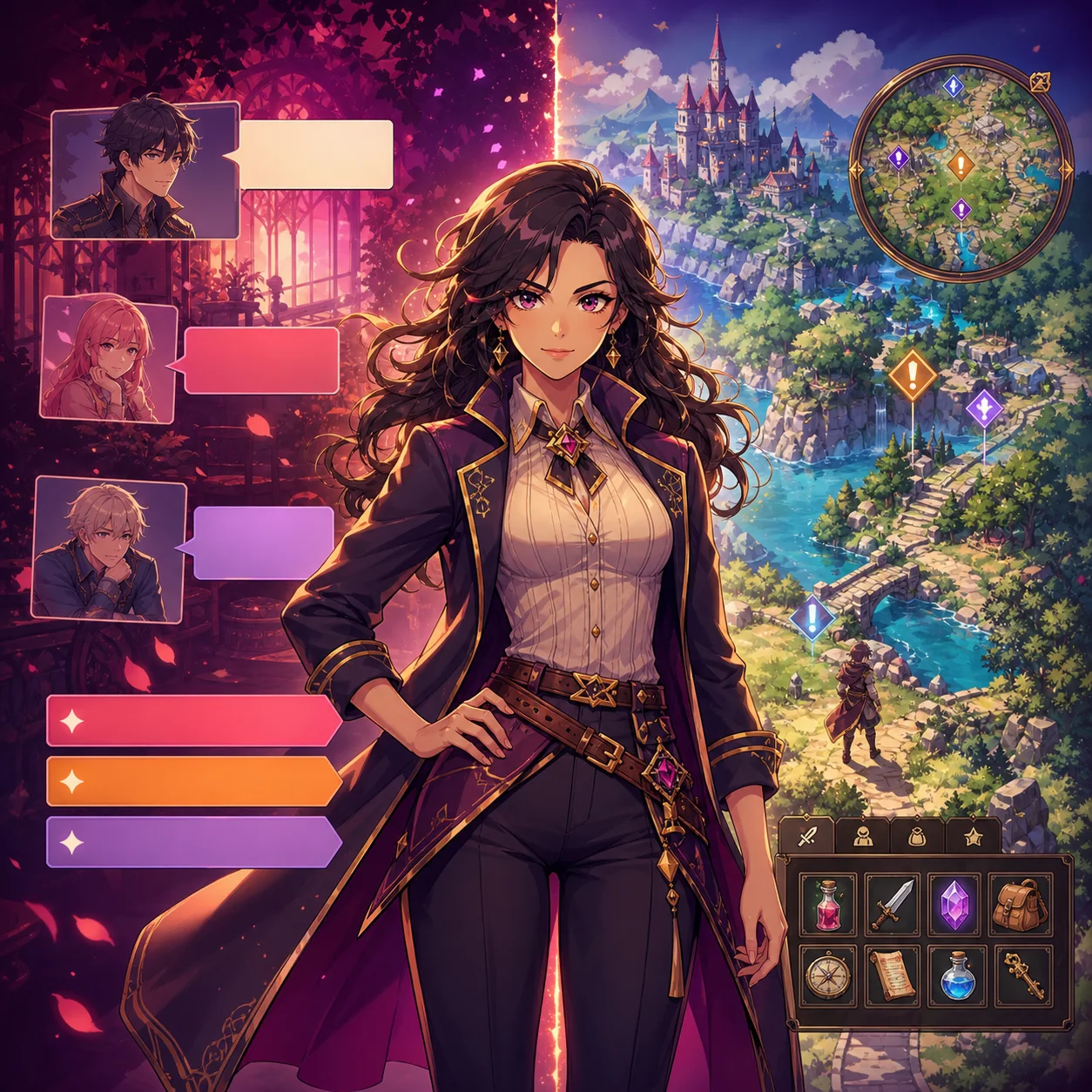
The useful difference is not “reading versus fighting.” It is the question of what the player does between two important story moments.
A visual novel is usually organised around dialogue, images, music and decisions. Its core state might be a set of route flags, relationship values and completed scenes. The player advances through authored content, and a choice changes which part of the narrative graph comes next.
An RPG adds a more continuous simulation. The player moves through a map, collects equipment, manages resources and often enters battles. The state becomes broader: position, party members, experience, inventory, quest stages and combat effects all need to be tracked.
Choices work differently
In a visual novel, a choice often changes the route immediately or sets a flag that pays off much later. In an RPG, choices may change the next event, but they can also affect a system: a shop inventory, a companion's skills or the enemies that appear in an area. The same narrative idea therefore needs different data structures and testing.
Why hybrid games feel different
Many story games mix the two formats. A calendar, map or life-sim loop gives the player a reason to make short-term plans; dialogue scenes deliver the authored story. The design challenge is pacing. If the simulation asks for too much routine work, the story loses momentum. If the story interrupts every action, the game can feel like a visual novel with a menu of errands.
What to look for as a player
Check where the game puts its feedback. A visual novel usually makes route changes visible through scenes and dialogue. An RPG makes them visible through numbers, maps and abilities. Neither approach is automatically deeper. The stronger choice is the one that supports the kind of story the game is trying to tell.
State is the hidden common ground
Both formats need a model of the player’s history. A visual novel may store route flags, relationship scores, discovered scenes and a current chapter. An RPG may store all of that plus map position, equipment, party status, quests and combat effects. The difference is not whether state exists, but how much of it the player changes between authored story beats.
This affects testing. A visual novel needs route coverage: developers must check that important combinations of choices lead to sensible scenes. An RPG needs route coverage as well as simulation coverage: the player might arrive at the same event with different levels, items or party members. The more systems overlap, the more important it becomes to give each condition a clear purpose.
Pacing is a technical choice
Visual novels control pacing through text speed, pauses, scene transitions and the timing of choices. RPGs add movement, exploration and repeated actions. Those loops can make a world feel larger, but they also create distance between two pieces of dialogue. Designers often use a map, calendar or resource system to give that distance meaning rather than making the player walk through empty space.
Hybrid games work best when the two layers support one another. A relationship value should affect more than a single line if it is central to the story. A combat or exploration system should reveal character, setting or consequence if the game is asking the player to spend time on it. When the layers do not connect, the result can feel like two separate games sharing a menu.
Choosing the right format as a player
If you want concentrated storytelling and frequent decisions, a visual novel may be the better fit. If you enjoy exploring, building a party and making longer-term resource choices, an RPG may offer more satisfying interaction. Many browser games sit between those descriptions, using visual-novel scenes for major moments and RPG-style systems for the time between them.
Neither format is automatically superior. The test is whether the mechanics reinforce the story. That is what makes a title on Lewdspot memorable: the player’s actions should feel connected to the characters, the setting and the direction of the narrative.
How to compare two games fairly
Start with the decision loop rather than the label. In a visual novel, ask how often the player makes a meaningful choice and how clearly the route responds. In an RPG, ask what exploration, combat or resource management adds to the story. A large map is not automatically meaningful exploration, just as a long list of dialogue choices is not automatically meaningful agency.
Then look at the cost of repetition. Visual novels often expect replay because different routes reveal different scenes. RPGs may expect repetition through battles, travel or resource gathering. Both can be satisfying when the repeated action has a purpose and becomes efficient over time. Both can become tiring when the player is asked to repeat steps without new information or a changed decision.
The strongest hybrid games use each format where it is most effective. Exploration can establish a place, a conversation can reveal a character, and a system can make the player's next decision more informed. That relationship between mechanics and story is more useful than arguing over genre boundaries.
Genre labels are useful as a first filter, but they are not a substitute for understanding the loop. A title described as an RPG may have very light combat and a strong dialogue system; a visual novel may include schedules, exploration and numerical relationships. Reading a short description of the core loop tells you more than the label alone. It also helps you choose a game that matches the amount of agency, repetition and story focus you actually want.
This perspective is useful when choosing a game online. Before starting, decide whether you want a focused narrative, a longer simulation loop or a balance of both. The right match usually produces a better experience than chasing a genre label that promises features the game barely uses.
A clear understanding of the core loop makes that choice easier and sets more realistic expectations before the first scene loads.